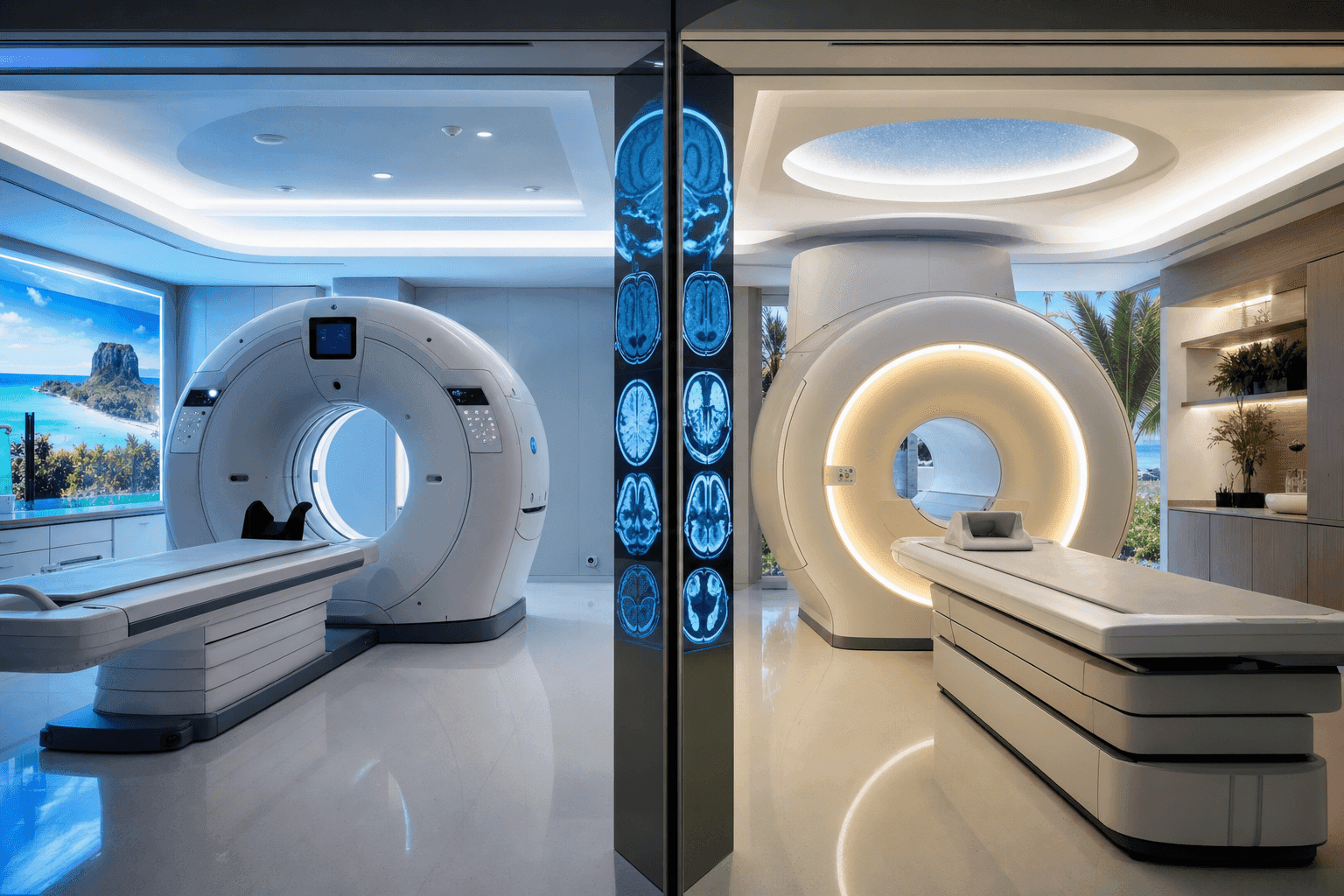
Two powerful scans, two different tools
If your doctor has recommended a CT scan or an MRI, you may be wondering what the difference is and why one was chosen over the other. Both produce detailed cross sectional images, meaning they show your body in thin slices rather than as a single flat picture. Both are available in Mauritius, and both can reveal problems that a plain X-ray cannot. Yet they work in completely different ways, and each has its own strengths.
How a CT scan works
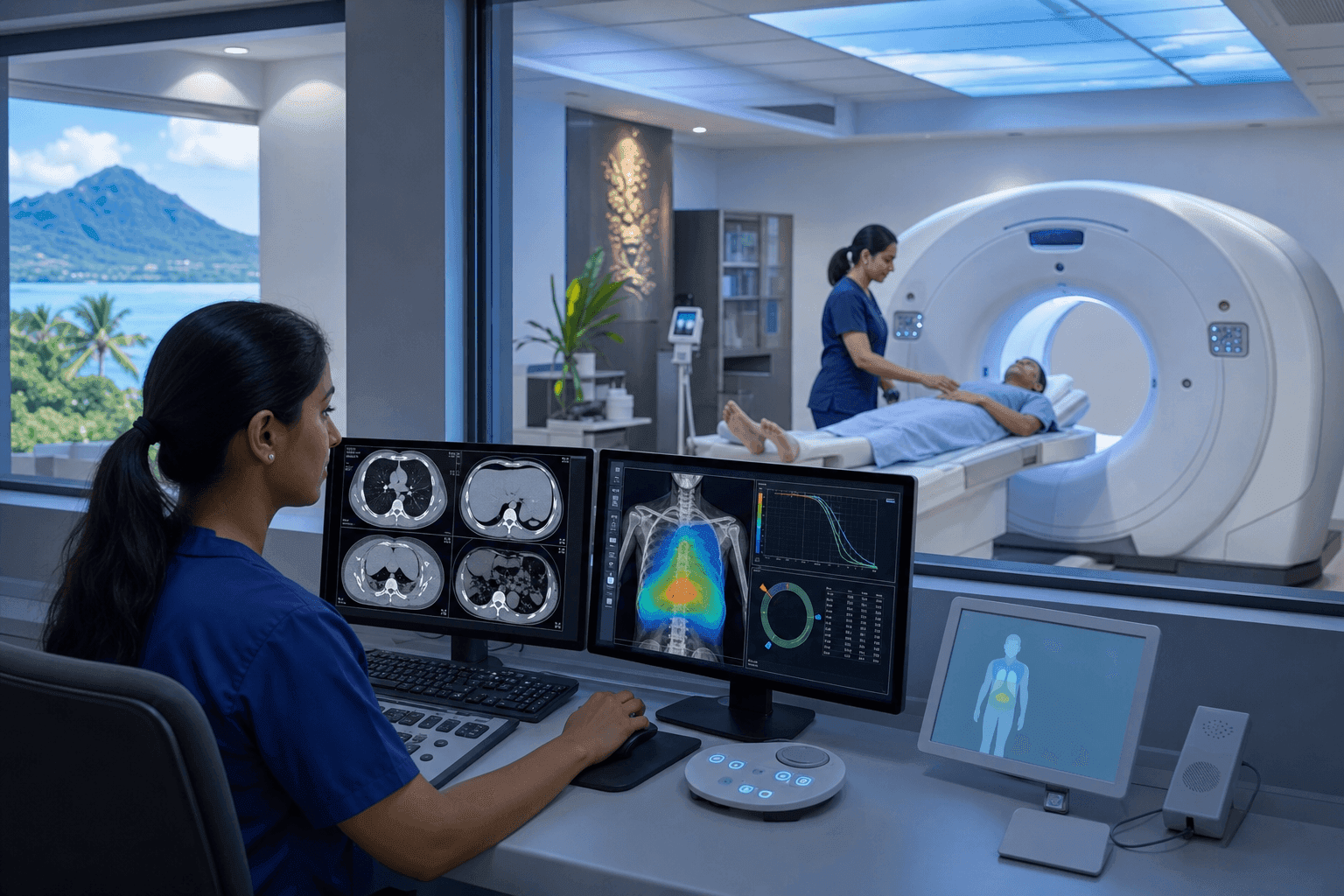
CT stands for computed tomography. A CT scanner is essentially a very fast, very clever X-ray machine. Instead of taking a single picture, it sends X-ray beams through your body from many angles as the machine rotates around you. A computer then combines all of these views into detailed slices that can be stacked to build a three dimensional picture.
Because it is based on X-rays, CT uses ionising radiation. Modern scanners are designed to keep the dose as low as possible, and the information a CT provides is often well worth it. A CT scan is very fast, with the actual imaging often taking only seconds. That speed makes it the test of choice in emergencies, for example after a serious accident or when a stroke is suspected and every minute counts.
CT is excellent for looking at bone, bleeding, the lungs, and many problems in the abdomen. It is also very good at guiding urgent decisions because the images appear so quickly.
How an MRI works
MRI stands for magnetic resonance imaging. It does not use X-rays or any ionising radiation at all. Instead it uses a strong magnetic field and radio waves. The scanner gently nudges the water molecules in your body and listens to the tiny signals they send back. A computer turns these signals into remarkably detailed images of soft tissue.
This is where MRI shines. It shows muscles, ligaments, the brain, the spinal cord, and organs with a level of soft tissue detail that CT cannot match. If your doctor needs to study a knee ligament, a slipped disc, or fine detail in the brain, MRI is often the best choice.
The trade offs are time and comfort. An MRI takes longer, often twenty to forty five minutes, and you must lie still inside a tunnel shaped magnet. The machine is noisy, so you will usually be given headphones or ear protection. People who feel uneasy in enclosed spaces should mention this beforehand, as there are ways to help.
Safety and who should take care
Because CT uses radiation, doctors weigh the benefit against the small added risk, and they are especially careful with children and during pregnancy. MRI has no radiation, but the powerful magnet means metal is a serious concern. If you have a pacemaker, certain implants, metal fragments, or surgical clips, you must tell the team before the scan. Always complete the safety questionnaire honestly so the staff can keep you safe.
Both scans sometimes use a contrast agent, a dye given through a vein that makes certain tissues or blood vessels stand out. The contrast used for CT is different from the one used for MRI, and the team will ask about allergies and kidney function first.
Choosing between them
You do not have to make this choice yourself. Your doctor selects the test that best answers the question about your health. As a simple guide, CT is fast and superb for bone, bleeding, and the chest and abdomen, especially in emergencies. MRI is slower but unmatched for soft tissue such as the brain, spine, and joints, and it uses no radiation.
Sometimes the two tests are used together. A CT might give a rapid first answer, and an MRI might follow to study a specific area in greater detail. They are partners rather than rivals.
The takeaway
CT and MRI are two of the most valuable imaging tools available in Mauritius. CT uses X-rays to deliver fast, detailed pictures and is ideal in urgent situations. MRI uses magnets and radio waves to reveal soft tissue in extraordinary detail without any radiation. Knowing why your doctor chose one over the other can make the experience far less daunting. If you are unsure, ask the imaging team, they will gladly explain what your scan involves and how to prepare.
Clear imaging is the first step to an accurate diagnosis. Explore the wider Medtech health ecosystem.